

We Serve the Latest News of IP Industry
for Your Reference
Guizhou Renhuai Kuaishou Liquor Sales Co., Ltd. applied for the registration of the trademark of "Kuaishou Laotie" on class 35 ("accounting") goods on August 29, 2017 (hereinafter referred to as "disputed trademark"), and was approved for registration on March 28, 2020. Beijing Dajia Internet Information Technology Co., Ltd. (hereinafter referred to as "the plaintiff") is the obligee of the cited trademarks 1 to 7, and filed a request for invalidation of the disputed trademark on September 2, 2020, claiming that the disputed trademark and the cited trademarks 1 to 3 and 7 constitute similar trademarks used in the same or similar services; the cited trademarks 4-6 have constituted well-known trademarks, and the trademark in dispute is the imitation and plagiarism of the above-mentioned trademarks; the plaintiff also claimed that the disputed trademark is deceptive.
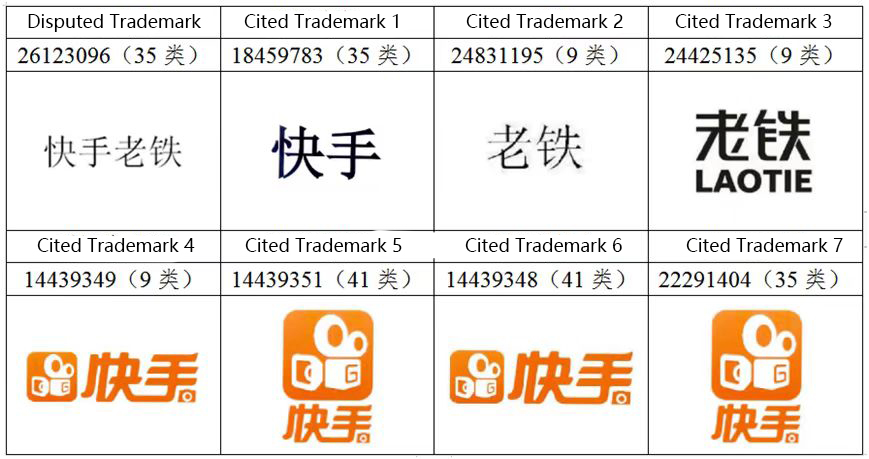
The National Intellectual Property Administration believes that the disputed trademark and the cited trademarks 1-3 and 7 do not belong to similar goods or services; the evidence in the case is not sufficient enough to fully reflect that the cited trademarks 4-6 constitute well-known trademarks, hence ruled to maintain the disputed trademark. The plaintiff refused to accept the ruling, and appealed to the Beijing Intellectual Property Court.
The court held that, the disputed trademark is similar to the cited trademarks 1-3 and 7 in terms of text composition, naming, meaning and so on, thus forming a similar trademark. However, the "accounting" service approved by the disputed trademark differs significantly from the "advertising, marketing, batteries, battery chargers, headphones, online advertising of computer networks" and other goods and services of the cited trademarks in terms of function, purpose, service content, service mode, etc., and does not belong to similar goods or services. Therefore, the disputed trademark and the cited trademarks do not constitute similar trademarks used on similar goods or services, and the trademark in dispute does not violate the provisions of Article 31 of the trademark law.
Secondly, the plaintiff claimed that the disputed trademark was a copy and imitation of its registered well-known trademark, so the court held that whether the cited trademarks 5 and 6 constituted well-known trademarks before the date of application for the disputed trademark was the focus of dispute. The plaintiff provided a large amount of evidence, such as the app’s download ranking, media reports and honors, which is sufficient enough to prove that the cited trademarks 5 and 6 have constituted well-known trademarks used in "program production, entertainment, entertainment information" and other services. At the same time, the disputed trademark "Kuaishou Laotie" includes the significant identification of "Kuaishou" of the cited trademarks 5 and 6, and "Laotie" is also a trademark registered and used by the plaintiff earlier, so it constitutes a copy and imitation of the cited trademarks 5 and 6.
Although there are differences between "accounting" service and "entertainment, entertainment information" and other services, the "program production, entertainment, entertainment information" and other services approved for use in the cited trademarks 5 and 6 are services for ordinary consumers provided by the Kuaishou platform, including both video producers on the platform and all ordinary Kuaishou users. In view of the fact that "Kuaishou" has up to 700 million registered users and is almost a short video platform participated by the whole nation, its service object must include the object of "accounting" service, and the service objects of the disputed trademark and the cited trademarks will undoubtedly overlap with one another. In addition, based on the huge flow of Kuaishou platform, the main body engaged in "accounting" services may also carry out publicity through the platform, so "accounting" services must rely on "program production, entertainment, entertainment information" and other services for publicity, and there may also be connections in the service content. Therefore, when the relevant public sees the trademark in dispute, it is easy for them to establish a considerable degree of connection with the plaintiff's well-known trademark, hence mistakenly believe that its service comes from the plaintiff or has a specific connection with the plaintiff, and then destroy the close connection between the cited trademarks 5 and 6 and the approved use services, weaken its significance, and cause the interests of the plaintiff, as the owner of the well-known trademark, to be damaged. Therefore, the trademark in dispute violates the provisions of Article 13.3 of the Trademark Law, and shall therefore be declared invalid according to law.
In conclusion, the court supported the plaintiff's claim, revoked the ruling of CNIPA and requested CNIPA to make a new ruling. This case involves the issue of enlarging the protection over well-known trademarks. The court fully considered the popularity of the cited trademarks, the similarity between the disputed trademarks and the cited trademarks, as well as the relevance of the service items approved and used by both parties' trademarks, supported the request for the cross-class enlargement of the protection over well-known trademarks, hence securing new and powerful support for the obligees of well-known trademarks.